Everyone starts with a Jupyter notebook. You load the data, train a model, get 94% accuracy, and feel like a genius. Then someone asks you to run it on live data every 15 minutes and suddenly you're questioning every life decision that led you here.
The Notebook Trap
Notebooks are incredible for exploration. They're also terrible for production. The moment you have cells that need to run in a specific order, hidden state from re-executed cells, and that one cell you accidentally deleted but the variable still exists in memory — you're in trouble.
The first step to building a real pipeline is admitting that your notebook isn't one.
From Notebook to Pipeline
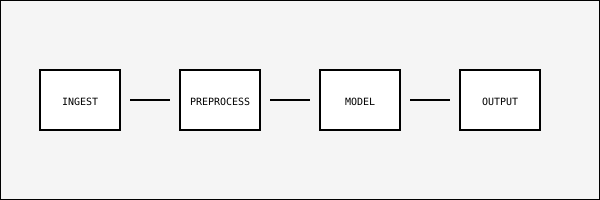
I started by extracting each logical step into its own Python module: data ingestion, preprocessing, feature engineering, model inference, and post-processing. Each module has a clear input and output contract. No globals. No side effects. Just functions that take data in and push data out.
The orchestration layer ties them together. I've used Airflow for scheduled batch jobs and FastAPI for real-time inference endpoints. The key insight: your ML code should have zero awareness of how it's being orchestrated.
Data Validation is Everything
The model doesn't break at 3 AM because of bad code. It breaks because someone upstream changed a column name, or a sensor started returning nulls, or the date format switched from ISO to American. I use Pydantic schemas at every pipeline boundary to validate data shape and types before anything touches the model.
Monitoring in Production
Accuracy on a test set means nothing once you're live. I track prediction distributions, input feature drift, and latency percentiles. When the distribution of predictions shifts more than 2 standard deviations from the training baseline, an alert fires. Most "model degradation" is actually data degradation.
Lessons Learned
- Version everything — data, code, models, and configs. DVC handles data versioning, Git handles code, and MLflow tracks experiments.
- Fail loudly — silent failures in ML pipelines compound. By the time you notice, you've been serving garbage predictions for days.
- Keep it boring — the best production ML code looks like regular software engineering. No clever tricks. No magic. Just clean, tested, observable code.
The gap between a working notebook and a production pipeline is enormous. But once you bridge it, you stop being the person who "built a model" and start being the person who "shipped a system."